
Currently the phrase appears 3 times. I’ve woven it in naturally at 4 more spots, each framed from a first-person “in my experience” / “as an SEO Specialist in Thrissur, Kerala, I’d suggest” angle, spread across different sections so it doesn’t feel stuffed.
What Makes an SEO Audit So Important? A Perspective From an SEO Expert in Thrissur, Kerala

A client called me last month convinced something was broken on her site. Traffic had been sliding for weeks and she couldn’t figure out why. Turned out it wasn’t one big thing it was five small things stacked on top of each other: a slow-loading homepage, three pages Google had quietly stopped indexing, and meta descriptions that hadn’t been touched since the site launched. That’s basically what an SEO audit exists to catch.
An SEO audit, at its simplest, means going through your entire website piece by piece speed, crawlability, content, the works and figuring out what’s actually helping you and what’s holding you back. I tend to describe it to clients as a blood test for their website. You can feel like everything’s running fine and still get results back that tell a completely different story. Working as Freelance Digital Marketer in Thrissur, Kerala , I’ve lost count of how many business owners walk in assuming their site is in good shape, then we find broken redirects, duplicate page titles, or images with zero alt text small stuff individually, but it adds up to real lost visibility.
Here’s the thing about SEO: it never sits still. Google rolls out updates without warning, competitors are constantly trying to muscle into your rankings, and your own website ages even when you’re not touching it plugins go stale, old blog posts become irrelevant, new pages get added without anyone checking if they’re set up correctly. None of this breaks your site overnight. It erodes it slowly. Get into the habit of auditing regularly and you’ll catch these things while they’re still cheap and easy fixes, not after they’ve cost you six months of traffic.
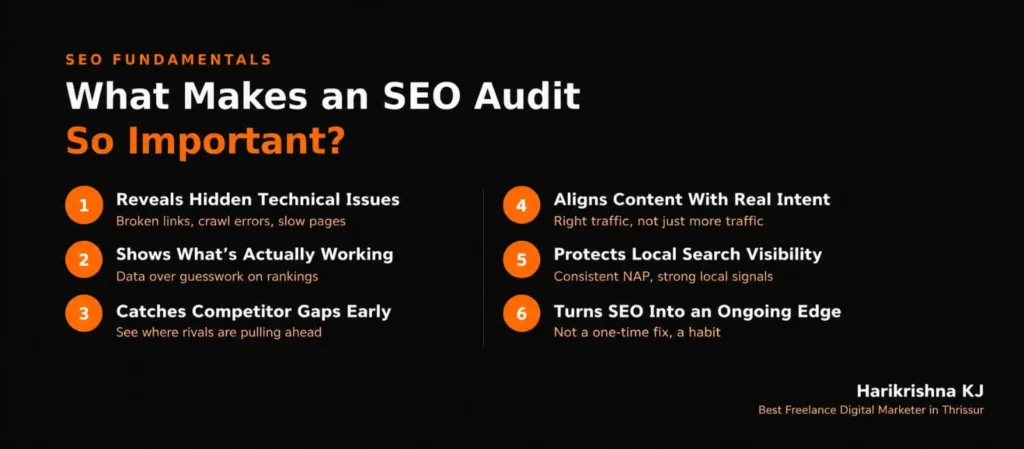
What Exactly Is an SEO Audit?
Think of it as a full diagnostic pass across five areas: your site’s technical setup, the on-page elements on individual pages, the actual quality of your content, your backlink profile, and how real people experience using your site.
Why bother? Because problems you can’t see are problems you can’t fix. I’ve seen gorgeous, professionally designed websites that were essentially invisible to Google because of a handful of crawl errors blocking key pages from being indexed at all. I’ve also seen sites ranking decently just for keywords that had nothing to do with what the business actually sold.
There’s more upside here than rankings alone. A good audit usually speeds things up, patches security gaps, gives you a clearer sense of what content actually needs work, and this is the part clients love often turns up a fix that takes fifteen minutes but produces a noticeable bump within a few weeks.
Why Bother Auditing Regularly? Lessons From an SEO Expert in Thrissur , Kerala
Nobody skips servicing their car and expects it to run perfectly forever. Your website works the same way.
Rankings tend to climb once you’ve cleaned up the small stuff that was quietly keeping pages from competing. Visitors stick around longer once load times, clunky menus, and mobile glitches get sorted out these are exactly the kinds of problems an audit surfaces every single time. Traffic grows because you’re finally targeting what people are genuinely searching for instead of guessing. And once the right visitors land on pages that actually work, conversions tend to follow without you having to do much else.
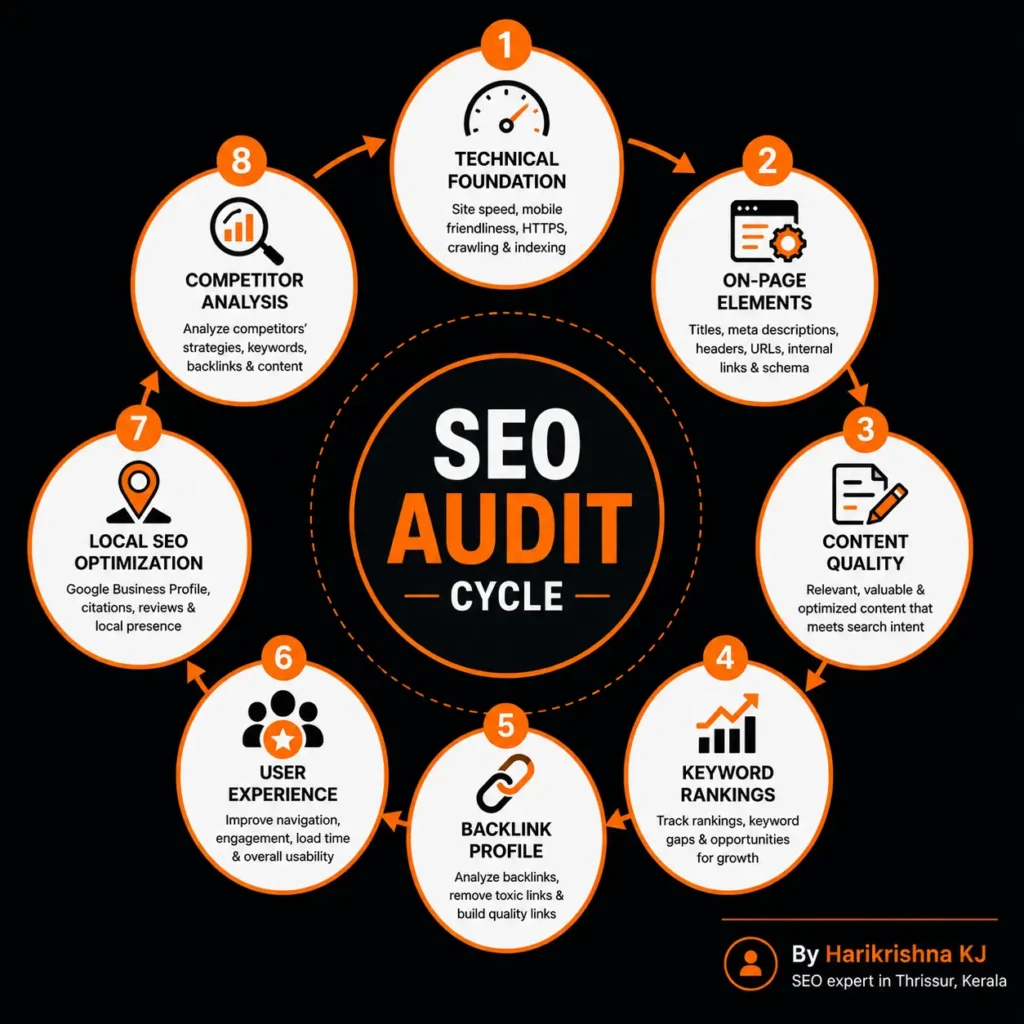
Step 1: Check the Technical Foundation
This is the part nothing else works without. Doesn’t matter how good your content is if Google can’t properly crawl and index the page it’s sitting on.
Speed comes first. A page that drags will lose visitors and tell search engines your site isn’t worth surfacing. Mobile responsiveness matters just as much, if not more Google evaluates your mobile version before anything else these days, and most searches happen on a phone anyway. HTTPS isn’t a nice-to-have anymore either; browsers will actively warn people away from unsecured pages, and that’s the fastest way to torch trust before someone’s even read your content.
From there, look at crawlability. Can search engine bots actually navigate your site without running into dead links or scripts blocking their path? And check your indexing pull up which pages Google’s actually showing in its index versus which ones it’s silently ignoring. That gap tells you a lot. As an SEO Specialist in Thrissur, Kerala, this is usually the first thing I check on any new client site, because a beautiful homepage means nothing if half your pages aren’t even being indexed.
Step 2: Go Through the On-Page Details
Every page has its own set of signals telling Google what it’s actually about this is where you check whether those signals are doing their job.
Start with title tags. Are they distinct from page to page, descriptive, and not running too long? Meta descriptions won’t move your ranking directly anymore, but a well-written one is still the difference between someone clicking your result or scrolling past it. Header tags need a sensible hierarchy H1 down through H2s and H3s with keywords appearing where they fit naturally rather than wedged in.
URLs are something most site owners completely ignore, and they shouldn’t. A clean, readable URL beats a messy string of random characters every time, both for users and for search engines trying to understand your site structure. And don’t sleep on internal linking it’s one of the simplest ways to push authority toward your most important pages.
Step 3: Look Hard at Your Content
This is where I see the most damage, honestly. Thin pages ones with barely any real substance just don’t give Google enough to work with, so they rarely rank no matter how well-optimized everything else is. Duplicate content is another quiet killer, whether you’ve repeated yourself across your own pages or pulled text from somewhere else; either way, search engines get confused about which version deserves to show up.
Stale content is a problem people rarely think to check. Old stats, screenshots from three redesigns ago, mentions of products you don’t even carry anymore all of it tells Google (and your visitors) that nobody’s minding the store. Keyword optimization still matters, but it should read naturally, not feel forced. And above all of that: does your content actually answer what someone typed into Google, or does it just happen to contain the right words without delivering anything useful? From my experience as an SEO Specialist in Thrissur, Kerala, this is the step business owners skip most often they’ll happily fix a broken link but won’t touch a page of content that’s quietly gone stale.
Step 4 : Pull Your Keyword Rankings and See Where You Stand .
This step is just honesty where are you actually ranking right now? Some keywords will be carrying real weight; others will have flatlined months ago without anyone noticing. Keyword gap analysis is where it gets interesting these are the terms your competitors rank for that you’ve never even tried to target.
Comparing your pages directly against competitors usually explains why they’re beating you. Sometimes it’s deeper content. Sometimes it’s just more backlinks. Sometimes their on-page work is simply tighter than yours. Track your overall search visibility too, since that number tells you whether you’re gaining or losing ground across the board, not just on individual terms.
Step 5: Take a Hard Look at Your Backlinks
Backlinks still carry serious weight in how Google ranks you, but it’s quality over quantity every time. Start by reviewing the good ones links coming from relevant, well-regarded sites that actually lend you credibility. Then go hunting for the bad ones: spammy, irrelevant sites linking to you that could be dragging your rankings down rather than helping.
Check your domain authority to get a rough sense of where you stand competitively, and look at where your competitors are earning links. If they got a mention from a particular site, there’s a real chance you could too.
Step 6: Evaluate the Actual User Experience
Google factors in how people behave on your site, so this step isn’t optional anymore. Test your navigation can someone find what they need in a couple of clicks, or are they wandering around? Check mobile usability carefully too; buttons and layouts that look fine on a desktop screen sometimes break completely on a phone.
Watch your bounce rate closely. A high one almost always means people aren’t finding what they expected the second they land. And look at engagement metrics time on page, how far people scroll to get an honest read on whether your content is actually holding anyone’s attention or just sitting there.
Step 7: Don’t Skip Local SEO: Tips From an SEO Expert in Thrissur
If you’re running a business tied to a specific city or area, this step can make or break your visibility. Start with your Google Business Profile accurate hours, the right business category, current photos, and regular updates matter far more than most owners realize. Build citations across relevant local directories too, since that strengthens your presence in the area you’re actually trying to serve.
NAP consistency trips up more businesses than you’d expect your Name, Address, and Phone number need to match exactly everywhere they appear online, because inconsistencies quietly chip away at local rankings. Local keyword optimization matters here too, weaving location terms in naturally rather than slapping them on as an afterthought. This is genuinely the part of the job I enjoy most as an SEO Specialist in Thrissur, Kerala helping local businesses dominate their own backyard before they even start thinking about expanding outward. As an SEO Specialist in Thrissur, Kerala, I’d suggest starting with your Google Business Profile if you’re tight on time, since it tends to move local visibility faster than almost anything else on this list.
Step 8: Keep an Eye on What Competitors Are Doing
Your competitors are basically doing free research for you, if you bother to look. Dig into their keyword targeting to see what’s actually driving their traffic. Study their content the format, the depth, the angle to understand why it’s working. And track their backlinks too; if they managed to earn a link from a particular source, there’s a decent shot you could land one from the same place.
The Tools I Actually Use as an SEO Expert in Thrissur , Kerala
You don’t need a shelf full of software for any of this just a handful of solid tools.
Google Search Console is non-negotiable; it shows you exactly how Google sees your site, straight from the source, including indexing problems and search performance data. Google Analytics fills in the behavioral side what people actually do once they’re on your pages. Page Speed Insights flags speed issues with specific recommendations attached. Screaming Frog crawls your entire site and surfaces technical problems you’d never catch manually. And Ahrefs or SEMrush round things out for backlink analysis, keyword research, and sizing up competitors between the two, you get a genuinely complete picture of where you stand.
Mistakes I See Constantly
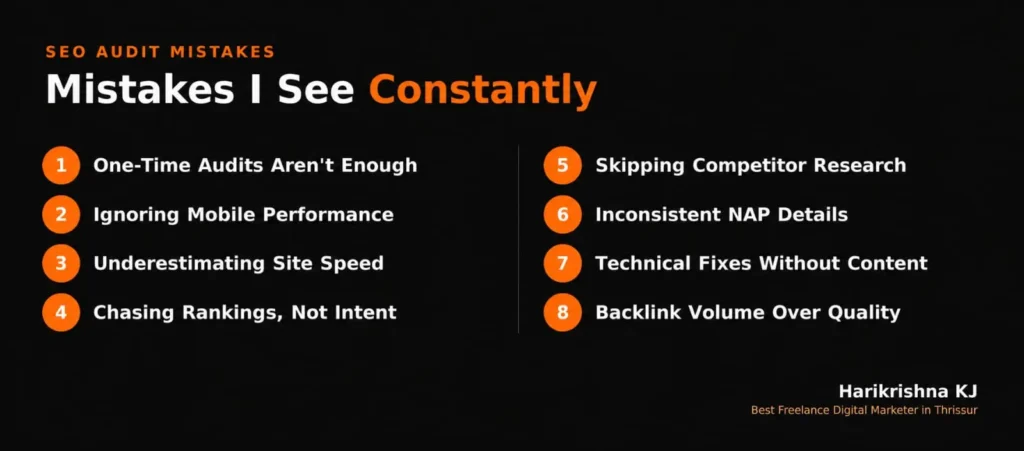
. One-Time Audits Aren’t Enough
SEO changes constantly, so regular audits are necessary to maintain and improve rankings.
2. Ignoring Mobile Performance
A poor mobile experience can hurt rankings and drive potential customers away.
3. Underestimating Site Speed
Slow-loading pages negatively affect both user experience and search visibility.
4. Chasing Rankings, Not Intent
Ranking for keywords is meaningless if they don’t attract the right audience.
5. Skipping Competitor Research
Analyzing competitors helps uncover opportunities and identify gaps in your strategy.
6. Inconsistent NAP Details
Different business details across directories can weaken local SEO performance.
7. Technical Fixes Without Content
Technical improvements alone won’t help if the content doesn’t satisfy user needs.
8. Backlink Volume Over Quality
A few relevant, authoritative links are usually more valuable than many low-quality ones
A Practical SEO Audit Checklist by an SEO Expert in Thrissur, Kerala
- Check site speed and Core Web Vitals
- Confirm mobile responsiveness
- Verify HTTPS is active sitewide
- Review crawlability and indexing status
- Audit title tags and meta descriptions
- Check header tag hierarchy
- Clean up URL structure
- Strengthen internal linking
- Identify thin or duplicate content
- Refresh outdated content
- Align content with search intent
- Track keyword rankings and gaps
- Compare performance against competitors
- Review backlink quality and disavow toxic links
- Check domain authority trends
- Test navigation and mobile usability
- Monitor bounce rate and engagement
- Optimize Google Business Profile
- Verify NAP consistency across platforms
- Research competitor keyword and content strategy
Wrapping It Up
An SEO audit isn’t busywork it’s the most reliable way to find out exactly where your site is bleeding rankings and where the actual opportunities are hiding. Technical health, on-page details, content quality, backlinks, local presence each piece feeds into the next, and together they build a site that’s faster, cleaner, and genuinely easier to find. Treat it as something you do regularly, not a box you check once, and you’ll stay ahead of both algorithm changes and whatever your competitors are quietly working on.
As an SEO Expert in Thrissur, Kerala and the Best Freelance Digital Marketer in Thrissur, I have seen how regular SEO audits help businesses uncover hidden opportunities, improve search visibility, and achieve sustainable online growth. These are the wrapping-up thoughts of an SEO expert in Thrissur, and if there’s one thing I’d want every business owner reading this to take away, it’s that an audit isn’t about finding fault it’s about finding the next thing worth fixing.
Recommended SEO Audit Video by an SEO Expert in Thrissur, Kerala
If you’d like a more detailed, step-by-step explanation of SEO audits, I’ve included one of my favorite video resources below. As a Best Freelance Digital Marketer in Thrissur and an SEO Expert in Thrissur, I often recommend this tutorial because it explains the SEO audit process in a practical and easy-to-understand way.
As an SMM Expert in Thrissur, These Are the Doubts I Hear Most Often
How often should I run an SEO audit? A full audit every three to six months works well for most businesses, with smaller technical checks happening monthly in between.
How long does a proper audit actually take? Depends entirely on your site’s size a small site might take a few hours, while a larger one could stretch into a couple of weeks.
Can I run an SEO audit myself? You can, especially using free tools like Google Search Console and Page Speed Insights though an experienced specialist will often spot issues that aren’t obvious unless you’ve done this dozens of times.
What separates a technical audit from an on-page audit? A technical audit covers crawlability, speed, and overall site architecture. An on-page audit zooms in on individual page elements titles, headers, content quality.
Will an SEO audit guarantee better rankings? No audit can promise that outright, but it pinpoints exactly what’s holding your site back, which meaningfully improves your odds of climbing over time.